Get

In Your Inbox

Dogster is reader-supported. When you buy via links on our site, we may earn an affiliate commission at no cost to you. Learn more.

How to Measure Your Dog for a Harness (Size Chart Included)

white pitbull with a dog harness

While a dog collar is useful as a tag carrier, every dog needs a harness, which provides extra support and safety when taking your dog for a stroll or run in the park. Finding the right size harness is vital for your dog’s safety and comfort, and that’s why learning how to attach a dog harness properly is such an important skill for dog owners. Dog harnesses are available in several sizes, and it is vital to measure your dog to ensure it fits correctly.

In this article, we’ll discuss how you can measure your dog for a harness, how it should fit, and the types of harnesses that are available.

Dogster divider_v2_NEW_MAY_24_

Before You Start

While harnesses are frequently sold by weight, it is best to use a measuring tape to get a more precise measurement. Knowing your dog’s weight and measurements will help you find the best harness for your dog. The same methods should be used to measure your dog, whether small, medium, or large. If your dog moves around a lot and doesn’t usually stand still, ask a family member or friend to help you hold your dog in place while you take measurements.
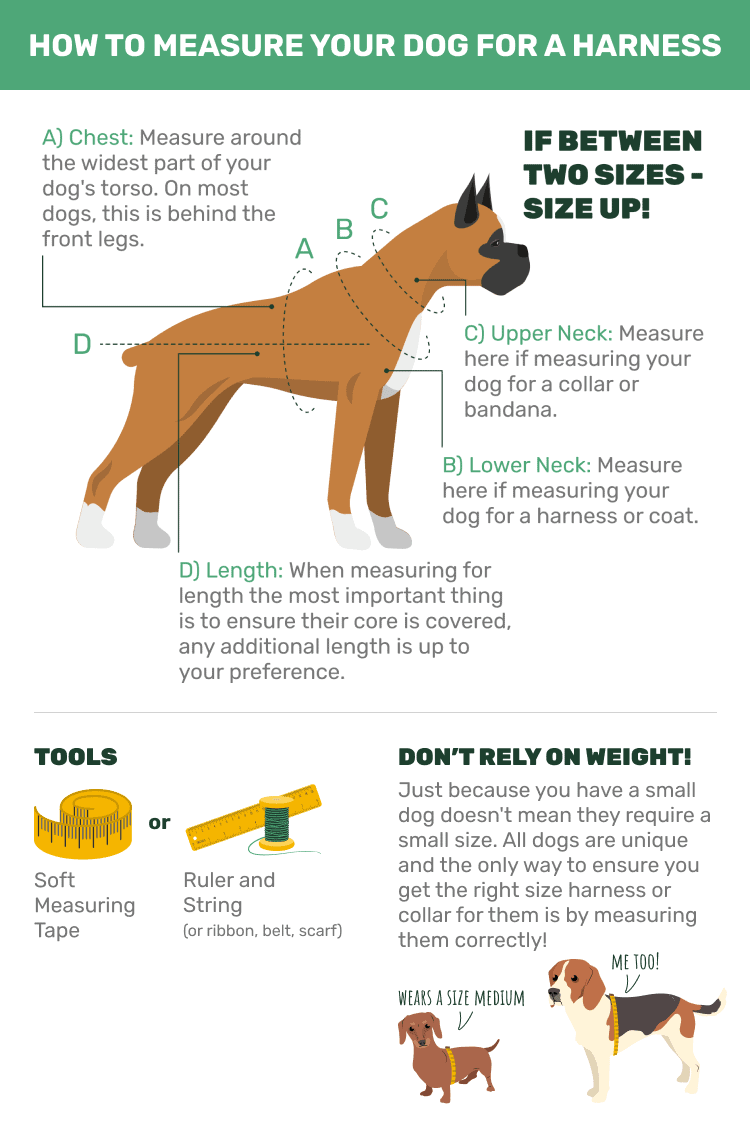
How to Measure Your Dog For a Harness
You’re welcome to use our images, but we require you link directly to this site for credit (ex. Image from Dogster)

The 4 Steps to Measure Your Dog for a Harness

A dog size chart will typically show four measurements: neck girth, chest girth, body length, and weight. Combining these measurements and weight will help you determine the correct size of your dog’s harness.

1. Neck Girth

Your dog’s neck circumference is measured around where the collar hits. Wrap the tape measure just below the narrow part of the neck, where your dog usually wears a collar. If you’re unsure, the correct spot is just above your dog’s shoulders. You will start just above their shoulders, at the nape of their neck, and wrap the tape down to the top of their chest and around to meet the other end. Remember, you need two fingers to fit comfortably between your dog and the harness.

dog standing on the meadow while owner adjusting the harness
Image Credit: Miriam Doerr Martin Frommherz, Shutterstock

2. Chest girth

The chest girth is the circumference of your dog’s chest. Find the widest part of your dog’s chest to measure their girth. The widest part of a dog’s chest is usually right behind the armpits but measure from the bottom of your dog’s rib cage.


3. Body length

Body length is measured from the base of your dog’s neck to the base of their tail or from the beginning of their shoulders to the end of their hips.

merle great dane dog in harness lying on grass
Image Credit: Ralphs_Fotos, Pixabay

4. Weight

Weight can also play a role in determining the appropriate size. You can weigh your dog using an ordinary bathroom scale. Weigh yourself and then hold your dog while standing on the scale. Subtract the first figure from the second to get your dog’s weight.

Dogster divider_v3_NEW_MAY_24_

How Should a Dog Harness Fit?

A dog harness should fit snugly around your dog’s body but should never be too tight. There is a general rule of thumb for determining if your dog’s harness fits correctly and is snug enough not to cause pain or discomfort. Of course, different harnesses are available that are suitable for specific breeds, and each harness requires a different approach to fit correctly.

Once you attach the harness around your dog’s chest, place two fingers in each section of the area between the harness and your dog. If the fingers fit comfortably, you can be confident that the harness sizing will not cause pain or discomfort, and your dog won’t be able to escape it.

If the two fingers don’t fit comfortably, you’ll need to adjust the harness. For harness sizes 0–4, the bottom belly strap should be four fingers away from the dog’s front legs; however, for harness sizes Baby 1 and Baby 2, a width of two fingers is sufficient.

Most harnesses are easily adjustable by tightening or loosening the straps.
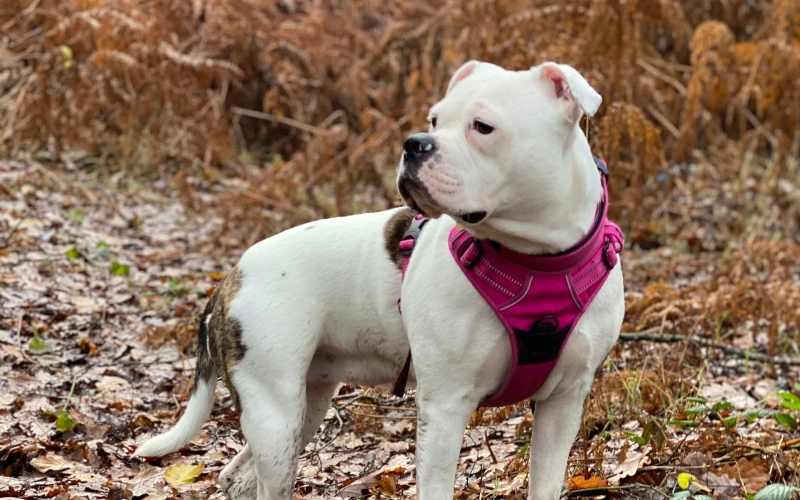
white pitbull with a dog harness
Image Credit: Lee Hardy, Unsplash

Types of Harnesses

The purpose of a dog harness is to guide your dog while they walk and reduce tension when they pull. It has straps that wrap around the dog’s torso and includes clips and D rings for the leash.

The different types include:
  • Back clip harness
  • Front clip harness
  • Step in harness
  • Dual clip harness

A back clip harness is ideal if your dog does not pull during walks and is well-trained to walk beside you. The leash easily attaches to the harness midway along the back to keep pressure off the throat. A front clip harness is ideal if your dog tends to pull when walking. There is a ring on the front chest strap to attach the leash, which will help stop your dog from pulling. The downside of this leash is that it can get tangled in the dog’s legs.

A dog steps into the straps of a step-in harness with both front paws, and the harness is then fastened at the back. This harness is ideal for dogs that don’t like to have something pulled over their heads.

Dual clip harnesses allow the leash to be attached to either the back or front clip. This makes them more versatile and can be used for either a gentle stroll or on a walk where you may need more control.

divider dog faces oct 2024

Conclusion

A dog harness with the right fit is crucial for the comfort and safety of your pet. Most dog harnesses come with a size chart; after taking your dog’s correct measurements and weight, you can find the best harness. Your dog’s harness should fit snugly but should never be too tight, and one way to determine if it’s too tight is by placing two fingers between the strap and your dog’s body to determine if it is a comfortable and functional fit.


Featured Image Credit: Lee Hardy, Unsplash

Want content like this delivered to you?

Sign Up For Our Newsletter

News, insights, expert advice, and everything dog

* By submitting, you agree to our Terms & Conditions and Privacy & Cookies Policy.

How useful was this post?

Click on a star to rate (you can leave written feedback after clicking submit)

Help us improve Dogster for pet parents!

Your feedback really matters.

What did you like about this post? Also how can we improve it?

Join the conversation

Leave a Reply

You’re very welcome to leave a comment or question. Please know that all comments must meet our community guidelines, and your email address will NOT be published. Let’s have a positive and constructive conversation.

Talk With A Vet Online

Peace of mind,
anywhere, anytime

Affordable vet advice

Can Dogs Eat Vegetable Oil? Vet-Verified Facts & FAQ

Vegetable oil is used in cooking and found in a variety of products, which may have you wondering if it’s safe for your...

What Happened to Mighty Dog Dog Food? Does It Still Exist in 2025? (Answered)

Many little dog owners are familiar with the Mighty Dog title. Carnation (the milk company) created this food line in 1973. But soon...

Miniature Dachshund Dog Breed: Info, Pictures, Origin & History

Did you know that the Miniature Dachshund is identical to a regular Dachshund in every way but size? A Miniature Dachshund must weigh...

Is a Foxtail in My Dog’s Nose Making Him Sneeze? Vet-Approved Guide

People who spend a lot of time outdoors with their dogs may already be familiar with foxtails, but not everyone knows about the...

More related

How Long Do Dalmatians Live? Vet-Reviewed Average Lifespan, Data & Care

Dalmatians are instantly recognizable, but you might not know much about the care they require, what lifestyle is best for them, how long...

Do Bernese Mountain Dogs Drool? Normal & Excessive Amounts Explained

Do you want to bring home a Bernese Mountain Dog? If so, you might be wondering whether they drool. The short answer is...

22 Hypoallergenic Dog Breeds: Info, Pictures & Origin

While no dog is truly hypoallergenic, numerous breeds have appeared over the centuries that have provided some sensitive individuals an opportunity for irritation-free...

Honoring Ted Rheingold and Betty Liddick – A Dogster Tribute

The Dogster and Catster brands have a very long history. Cat Fancy and Dog Fancy magazines, which have been around for 50 years,...

Keep reading

8 Best Dog Foods for American Staffordshire Terriers in 2025 – Reviews & Top Picks

The American Staffordshire Terrier is a medium-sized dog breed that will benefit from wet or dry dog food rich in lean meats. This muscular dog breed needs a well-balanced diet to meet their nutritional requirements while providing them with the...

Pit bull American Staffordshire Terrier with food bowl eating

Orijen Dog Food vs Blue Buffalo Dog Food: 2025 Comparison, Pros & Cons

With so many dog food options on the market, it’s easy to walk away with your hands empty and your head buzzing. If you’ve been buying dog food for some time or have recently adopted a puppy and have been...

Dogster_Dog Food Orijen VS Blue Buffalo

Can Dogs Eat Parsnips? Vet-Verified Nutrition Facts, Risks & Serving Tips

Parsnips may have a small fan club. They aren’t as popular as other vegetables in the Apiaceae family, such as carrots and celery. Some think the former are sweeter, but parsnips have a slight edge. Nevertheless, these vegetables pack a...

Dogster-Can-Dogs-Eat-Parsnips

Can Dogs Eat Frosted Flakes? Vet-Verified Facts & Nutrition Guide

While Frosted Flakes are a popular breakfast food for both children and adults, they’re not so great for dogs. Frosted Flakes don’t add any nutritional value to a dog’s diet, and the added sugar can lead to health complications if...

Can Dogs Eat Frosted Flakes

How Much Does The Farmer’s Dog Food Cost? 2025 Pricing Update

When you want to give your dog food that’s the best of the best, fresh is the way to go. But we all know that fresh food costs more than traditional kibble. So, how much does a food like The...

Finny with the farmer's dog food

Can Dogs Eat Sweet Potato Fries? Vet-Verified Nutrition Facts & Better Options

If you’re coming to this article concerned and ready to call the vet—just know that sweet potato fries aren’t toxic for your dog. However, if they are already made into fries, and you haven’t just cut up a fresh, sweet...

Dogster-Can-Dogs-Eat-Sweet-Potato-Fries

Can Dogs Have Onion Rings? Vet-Verified Facts & FAQ

You love giving your dog a bite of your food every now and then as a special treat, and most of the time, that’s fine. Many human foods are safe (though unhealthy) for canines to consume in moderation. But this...

Dogster-Can-Dogs-Have-Onion-Rings

Do Dogs Need Carbohydrates? Vet Approved Facts & Advice

Carbohydrates are sugars, fibers, and starch. Strictly speaking, dogs technically do not need carbohydrates in their diet, but because carbs produce energy, they are beneficial when included in a dog’s balanced diet. This means you should ensure your dog eats...

Cute Samoyed dog eating from bowl at home