10 Canadian Service Dog & Pet Therapy Statistics to Know in 2026


In this article
Note: This article’s statistics come from third-party sources and do not represent the opinions of this website.
Dogs and other pets have proven to be valuable human companions for centuries. Although their roles in our lives have changed, they are still part of our social and cultural heritage. Service dogs have been aiding humans for centuries, and currently, there’s a high demand for pet therapy in hospitals, nursing homes, and schools.1
Fortunately, service dogs and pet therapy programs are becoming more common in Canada. Here, we look at recent Canadian service dog and pet therapy statistics. They paint a picture of how the service dog and pet therapy industry is growing and what you can expect in the future.

The 10 Canadian Service Dog & Pet Therapy Statistics
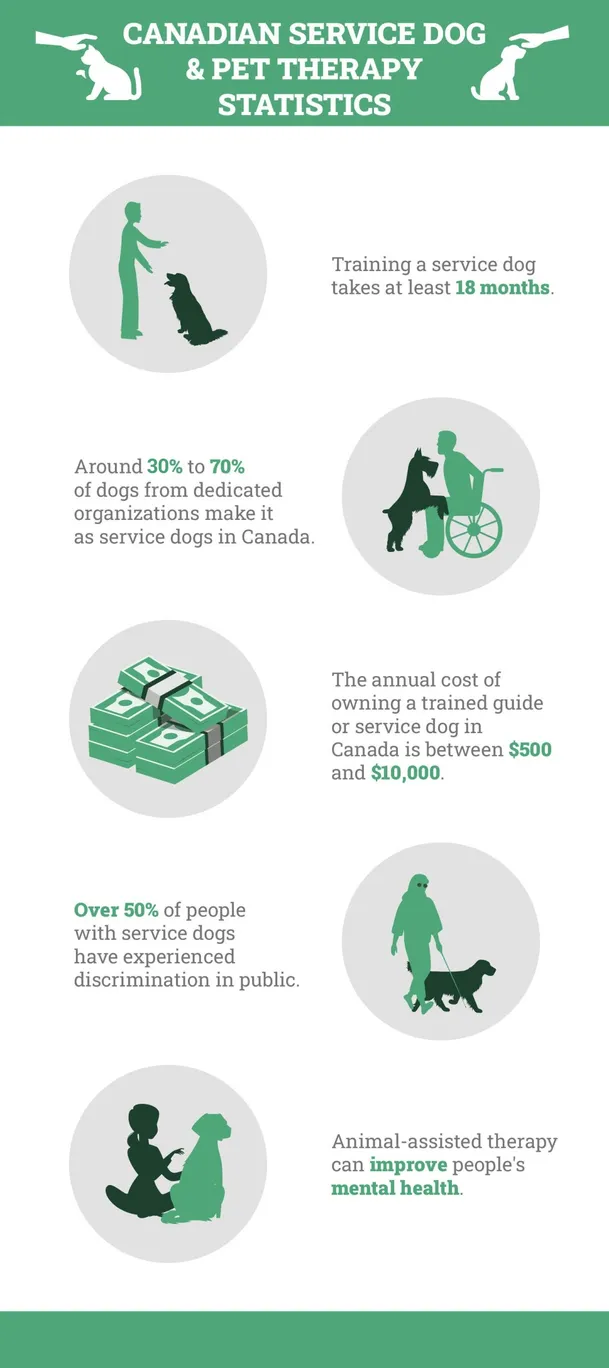
Training a service dog takes at least 18 months.
Around 30% to 70% of dogs from dedicated organizations make it as service dogs in Canada.
The annual cost of owning a trained guide or service dog in Canada is between $500 and $10,000.
Service dogs have the same broad access rights as Canadian citizens.
Transportation service providers must accommodate those who travel with service dogs in Canada.
Over 50% of people with service dogs have experienced discrimination in public.
Most Canadians agree that veterans with PTSD should have service dogs.
Animal-assisted therapy can improve people's mental health.
In Canada, over 100 registered pet therapy agencies are legally able to perform animal-assisted therapy.
Pet therapy can have a positive effect on patients' well-being.
Cost and Training of Service Dogs
1. Training a service dog takes at least 18 months.
(Service Dog Training Institute)
Service dogs make a significant difference in the quality of life for people with disabilities. They are trained to perform specific tasks, such as opening doors or retrieving dropped objects. They can also help people with mobility difficulties.
A service dog needs 18 months of training at a minimum, and it can longer to teach more specialized tasks. That said, several factors can speed up the training process. If you already have a dog at home, for example, it might be easier to train them than to buy a new dog. But if you have health concerns that may make it challenging to train your dog yourself, you should seriously consider having one specially trained by a service dog organization. Home-trained service dogs are also not always accepted everywhere.
2. Around 30% to 70% of dogs make it as service dogs in Canada.
(CAPDT)
Only a small percentage of dogs can be trained to become service dogs, as they need the right temperament and behavioural traits.
The criteria used for training service dogs vary among organizations, though professionally accredited ones have the high success rate of 50%–70%. Purely home-trained dogs have the low success rate of 30%. Home trainers who get professional help split the difference at 50% success.
3. The annual cost of owning a trained guide or service dog in Canada is between $500 and $10,000.
(Finder)
Many costs are associated with owning a service dog. It's not as simple as buying the dog and taking them home. After all, they’re a living being, not a piece of furniture or appliance. Service dogs must be specifically trained to help their partner, and they are expected to work for 8 to 10 years.
In Canada, the annual cost of a service dog is $500 and $10,000. Ongoing expenses include food, veterinarian care, grooming, ongoing training, and toys. Owners may also need specialized equipment, such as harnesses, vests, and transportation to and from the dog trainer's facilities.
All these costs depend on the type of work that the service dog does and where the owner lives.

Importance of Service Dogs
4. Service dogs have the same broad access rights as Canadian citizens.
(Support Dog Certification)
According to the Canadian government, various federal regulations affect service dogs, but broadly speaking, they are allowed wherever their handlers go, including places like recreation centres, stores, cinemas, malls, and other public facilities. It’s illegal for any business or organization to deny access to a service dog and their handler. That said, every province has its own laws regarding the rights of service dogs.
5. Transportation service providers must accommodate those who travel with service dogs in Canada.
(CTA)
One of the benefits of having a service dog is being able to travel with their assistance. All transportation agencies are required to recognise the importance of that ability and accept service dogs while providing proper accommodations, including appropriate seating, sufficient space, and accessible travel options.

6. Over 50% of people with service dogs have experienced discrimination in public.
(NCBI)
Unfortunately, despite the vital assistance that service dogs provide their owners, not everyone understands their purpose. Those with disabilities are often questioned about their disability and their dog, including the animal’s legitimacy. This is likely partially due to the over-hyped stereotyping of “fake” service dogs in the media. People are then incentivised to confront those with service dogs in a misguided attempt to prove their authenticity. But people with disabilities are not required to share their personal medical history nor the certification of their service dog. These interactions are a form of ableist discrimination and can be actively harmful.
7. Most Canadians agree that veterans with PTSD should have service dogs.
(MDPI)
Having a service dog as an assistant and companion helps veterans with PTSD deal with the incidences of their past and focus on their future. Service dogs do many things for veterans, such as alerting them if they have a panic attack and keeping them calm. They can also sense if the veteran is having a flashback or PTSD episode, and they will go beside them and comfort down.
The general Canadian public believes that veterans should have service dogs and supports their presence in public spaces.
Pet Therapy Statistics
8. Animal-assisted therapy can improve people's mental health.
(Veterinary Practice News)
Animal-assisted therapy is also known as pet therapy and entails physical contact between animals and humans. It has a positive effect on the mental health of those with PTSD, cancer, chronic pain, agoraphobia, and other illnesses. It’s also a promising approach for minimizing feelings of isolation or loneliness. That said, more research needs to be done to fully determine its benefits and drawbacks.

9. In Canada, over 100 registered pet therapy agencies are legally able to perform animal-assisted therapy.
(eMentalHealth)
Pet therapy is a growing field and is effective for various ailments. Canada alone has over 100 pet therapy agencies, including hospitals, healthcare facilities, schools, and other institutions. Certain ones use dogs, cats, birds, rabbits, and even horses and pigs.
The purpose of pet therapy is to improve the mental health of patients, so the animals are trained to interact with people through physical contact. Many people can offer their own pets as therapy animals. However, certain situations may require the support of a licensed pet therapist to help the patient through the healing process.
10. Pet therapy can have a positive effect on patients' well-being.
(PLoS One)
Treating illnesses, physical or mental, with pet therapy is a relatively new concept, but it’s proving to be beneficial. There's evidence that interactions with a therapy dog may improve symptoms of anxiety and depression and even pain.
Frequently Asked Questions
What is pet therapy?
Pet therapy/animal-assisted therapy involves using animals to help humans in medical, educational, and social settings. It typically takes place in hospitals and nursing homes, though schools and many other organizations are also starting to offer it.
(York University)
What psychiatric disorders qualify someone for a service dog?
A service dog can make all the difference for people with mental health disorders, which can include anxiety, bipolar disorder, depression, PTSD, and autism.
The first step towards determining whether a service dog is right for you is to talk to your doctor or mental health professional. Every person's situation is different, and your doctor will determine whether your symptoms would be alleviated by having a service dog.
(SDTSI)

Are service dogs allowed in schools in Canada?
Yes, Canada's Human Rights Act states that service dogs must be allowed to accompany their handlers wherever they go. However, the committee for the Accessibility for Ontarians for Disabilities Act points out that there are no nationwide education standards, and in many districts, students must ask their school board first and are sometimes denied.
(TCDSB, AODA)
How did animal-assisted therapy begin?
The history of animal-assisted therapy spans over 2,000 years. The earliest recorded use was in Greek around 600 B.C., during which animals were used to heal the sick. The Ancient Egyptians used dogs, cats, and ibises for this purpose, and other countries like India, China, and Japan also utilized animals for therapeutic reasons.
However, it wasn't until the mid-20th century that animal-assisted therapy came into practice in North America. Renowned psychiatrist Boris Levinson was a pioneer in this area.
(PATH Intl.)

What are the crucial qualities of a service dog?
If you are thinking of getting a service dog, know that they must have qualities like reliability, friendliness, and the ability to focus, remain calm, and follow basic and advanced commands. Your dog will be in public most of the time, so they’ll be expected to behave well around humans and other animals.
Service dogs are also specifically designated to help their owners with tasks related to their condition. It’s why they must be so thoroughly trained.
(24Petwatch)
What are the risks of pet therapy?
Although pet therapy has proven beneficial for many patients with health issues, it has a few risks. For example, people can have allergic reactions to pet dander, which can result in hives, swelling, or even shock.
The pets carry bacteria or other organisms on their fur or skin that could lead to an infection, which can be especially hazardous to those with weakened immune systems. Some patients may also get attached and not be willing to part with a pet once a therapy session is over.
(Healthline)
The Types of Service Dogs in Canada

Service dogs are trained to assist people with disabilities. They help those who are blind or deaf, people with epilepsy, and those who have diabetes. One type of service dog is a guide dog, which assists visually impaired people by guiding them from one place to another. Similarly, hearing dogs help the hearing impaired by responding to sounds like alarm clocks, doorbells, and smoke alarms. Mobility assistance dogs help physically disabled people get around more easily. They can pick up objects that have fallen and pull wheelchairs. A seizure alert dog alerts or responds to seizures. They do this through gestures like licking, barking, or nudging the person during an episode or in an impending episode. Psychiatric service dogs perform specific tasks for people with mental illnesses. For instance, they can interrupt obsessive behaviors like handwashing or hair-pulling. Medical emotional support dogs can provide comfort and support during panic attacks and other mental health-related crises. (24Petwatch)
Conclusion
While pets offer companionship and add a new dynamic to households all over the world, they can also provide many valuable services. Canada is home to various types of service dogs, which spend each day helping people in hospitals, schools, nursing homes, workplaces, and even their own houses. Public awareness of pet therapy has increased dramatically in recent years, and its benefits have become clear. From the comfort that they bring to patients in hospitals and senior homes to their ability to aid children and adults with disabilities, these loyal animals have vital roles in healthcare, education, and natural disaster relief.
Sources
Featured Image Credit: 24K Production, Shutterstock
Expert dog care, straight to your inbox
News, insights, expert advice, and everything dog.

No spam — unsubscribe anytime.
By signing up, you agree to our Terms & Conditions and Privacy & Cookies Policy.
How useful was this post?
Click a star to rate. You can leave written feedback afterwards. (We read all feedback.)
Nicole has loved animals of all sizes her whole life so it's no wonder she has dedicated her career to helping them through what she loves best: learning, writing, and sharing knowledge with others. She’s the proud mom of two dogs, a cat, and a human. With a degree in Education and 15+ years of writing experience, Nicole wants to help pet parents and pets around the planet to live happy, safe, and healthy lives.